

Recognizing supply chain risks
The environment surrounding corporate supply chains is undergoing significant change. In addition to geopolitical risks and natural disasters, the types of risks that companies face are expanding year by year to include cyberattacks, sustainability and human rights issues, and information disclosure.
Furthermore, because supply chains consist of complex networks of multiple companies, gaining full visibility is challenging. This difficulty extends past direct suppliers to those further upstream, making it hard to identify where hidden risks lie. In response to these diversifying risks, departments within companies including sustainability promotion, procurement and purchasing, and risk management can also become siloed, resulting in fragmented information and response policies, which is another major obstacle to risk management.
We don’t know how far we need to map our supply network.
Risk Management Department
Cosmetics manufacturer
On top of its traditional role managing cost, quality, and delivery, procurement departments, which handle many of these responses, also often receive inquiries and requests for action from both inside and outside the company. However, it’s hard to make progress when you’re feeling overwhelmed by the work. To move forward with effective measures and improvements, it is important to first visualize the full supply chain, assess the risks appropriately, and then turn the findings into improvement actions.
Visualizing complex connections
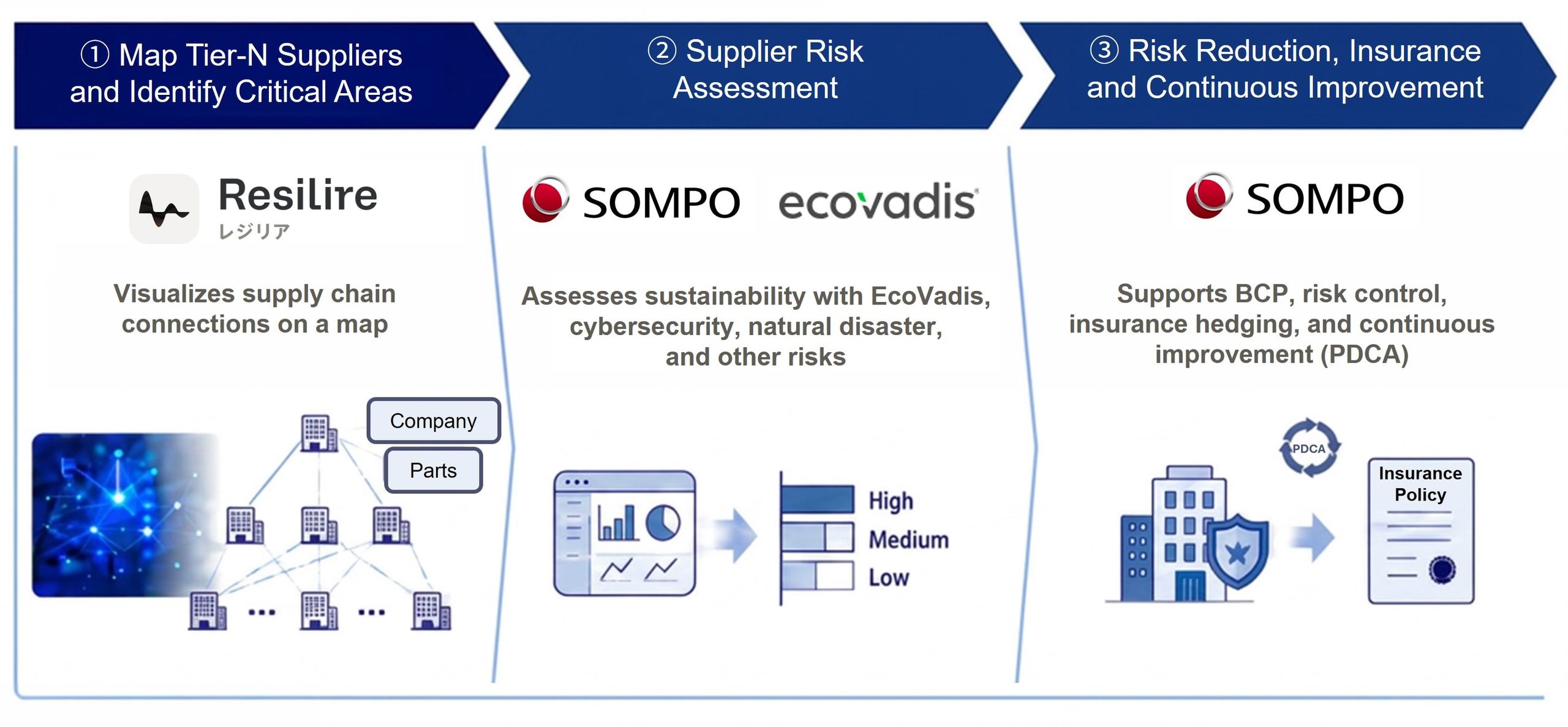
The first step is to map the complex, sprawling web of connections in the supply chain and identify the critical areas. We at Sompo Risk Management (Sompo Risk) are tackling this, as Sompo Group’s risk consulting firm.
In August 2026, Sompo Risk formed a capital and business alliance with Resilire, a provider of supply chain visualization systems. This has made it possible for us to visualize the multi-layered connections in a supply chain on Resilire’s platform. Combining this picture with Sompo Risk’s expertise in risk assessment and management makes it possible to identify where and what kinds of risks lie hidden, and provide end-to-end support through to the measures that follow.
This also strengthens disaster preparedness, something that is very much necessary for a disaster-prone country like Japan. When we can see how businesses and supply chain hubs are connected, it becomes easier to figure out which suppliers and locations might be affected during a disaster and how the situation could affect business continuity. Drawing on the natural disaster data and response experience that Sompo Group has built up, we are also able to help strengthen disaster prevention, disaster mitigation, and business continuity before disaster strikes.
Supply chain risks are so diverse that we can’t tell what to tackle first.
Procurement Department
Chemicals manufacturer
Visualizing and evaluating diverse risks
Once the supply chain’s connections are mapped out, the next step is to identify the risks that lie within them. Companies need to evaluate risk from diverse perspectives, including not only natural disasters but also cybersecurity, geopolitical, and sustainability issues. However, many customers struggle to ensure the objectivity needed for evaluation and lack the resources to conduct audits.
We do collect SAQs (Self-Assessment Questionnaires), but we cannot determine if they reflect the actual situation. We have neither the budget nor the resources to conduct on-site audits.
Procurement Department
Chemicals manufacturer
Further enhancing Sompo Risk’s capabilities in the sustainability domain is EcoVadis, which we started to partner with since June 2026. By combining EcoVadis’ assessment platform, which conducts ESG evaluations of supply chains, with its own consulting expertise, Sompo Risk supports the visualization and evaluation of ESG risks related to the environment, labor & human rights, ethics, and sustainable procurement.
However, assessment is not the final goal. Starting from the EcoVadis assessment results, Sompo Risk also helps establish systems that encourage improvement activities by suppliers and dialogue between buyers and suppliers. Further, by leveraging our expertise to extend into risk management that includes cybersecurity and business continuity, Sompo Risk lays the foundation for moving on to the next stage of “measures and improvements.”

From assessment to concrete measures and improvements
The final step is to translate the risks that have been identified and assessed into concrete measures and continuous improvements. We are leveraging expertise across a wide range of areas to provide end-to-end support, from the planning and implementation of measures to subsequent monitoring. Sompo Risk is also expanding collaboration with partners that have deep expertise in specific fields, such as Resilire and EcoVadis. By combining each partner’s strengths, along with risk financing through insurance from Sompo Japan, a fellow Sompo Group company, we are working together to strengthen the resilience of the entire supply chain.
Having our suppliers take the EcoVadis assessment showed us how far each one had progressed. But being assessed is a real hurdle for suppliers, so having Sompo Risk Management explain its value to them as consultants genuinely helped strengthen our supply chain resilience.
Sustainability Promotion Department
Materials manufacturer
These initiatives are still evolving. As an expert on strategic risk management, we continue to refine these services, tailoring them to the challenges facing not only buyer companies but also the suppliers further upstream, and contributing to the creation of resilient and sustainable supply chains.