



How far autonomous driving has progressed in Japan
As mobility gaps caused by driver shortages and the discontinuation of unprofitable bus routes become issues across Japan, expectations for autonomous driving are rising. While the United States and China are advancing the development of robotaxis (autonomous taxis) designed to navigate complex urban road environments, Japan, facing a shrinking and aging population, has prioritized autonomous buses to maintain public transportation in rural and suburban areas.
Levels of Driving Automation (Overview)
No autonomous driving: Driver is the primary operator.
- Level 0: Driver performs all driving operations
Driver assistance: Driver is still the primary operator.
- Level 1 (feet off): System provides driving support in only one direction, either longitudinal or lateral
- Level 2 (hands off): System provides driving support in both longitudinal and lateral directions
System-driven autonomous driving
- Level 3 (eyes off): Autonomous driving under certain conditions (outside these conditions, driver ensures safety)
- Level 4 (driverless): Autonomous driving under certain conditions
- Level 5: Autonomous driving anytime, anywhere
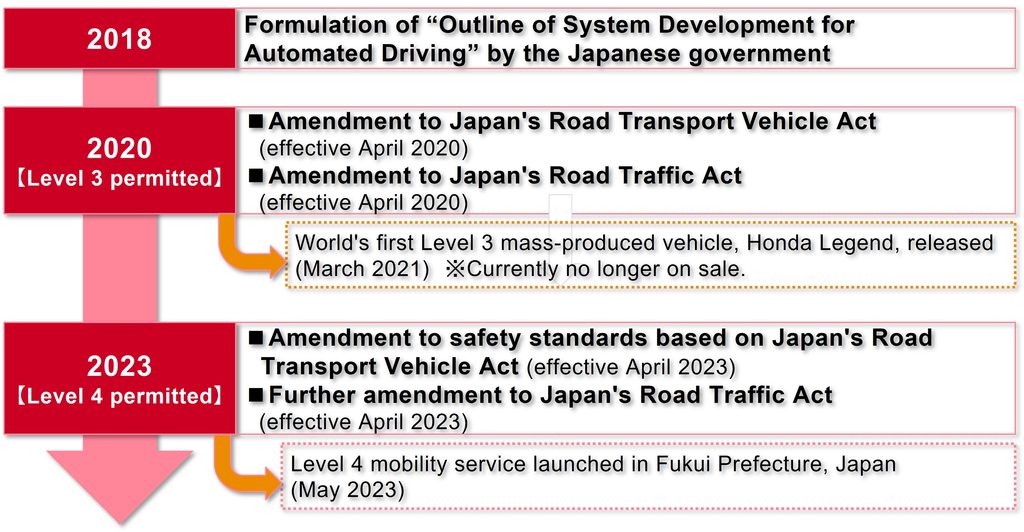
Regulatory frameworks have also advanced. Following the formulation of Japan’s Outline of System Development for Automated Driving in 2018, Level 3 autonomous driving was permitted in 2020, and Level 4, which does not require a driver under specific conditions, was permitted in 2023. In May of the same year, a Level 4 mobility service began in Eiheiji Town, Fukui Prefecture, and as of June 2026, deployment has expanded to 11 locations nationwide.
However, there are still barriers on the road to full-scale adoption. Many of the demonstration experiments are still carried out in a Level 2 format, where a driver remains in the vehicle and switches to manual driving as necessary, and passengers are required to be seated. It will be necessary to ensure safety when implementing Level 4 operation in complex situations such as passing parked vehicles. Another example is something as simple as making right turns at intersections because Japan drives on the left side of the road. Safety must also be carefully considered when allowing standing passengers on busy bus routes.
Meanwhile, the integration of autonomous driving technology into passenger cars is also gaining momentum in Japan. In addition to efforts to introduce robotaxis in urban areas, a new technological approach called “Level 2++,” in which AI assists driving while the driver remains responsible for monitoring, is attracting attention. Japan’s autonomous driving is expanding its scope of application and range of technological options, from buses that support regional transportation to solutions that facilitate people’s mobility.
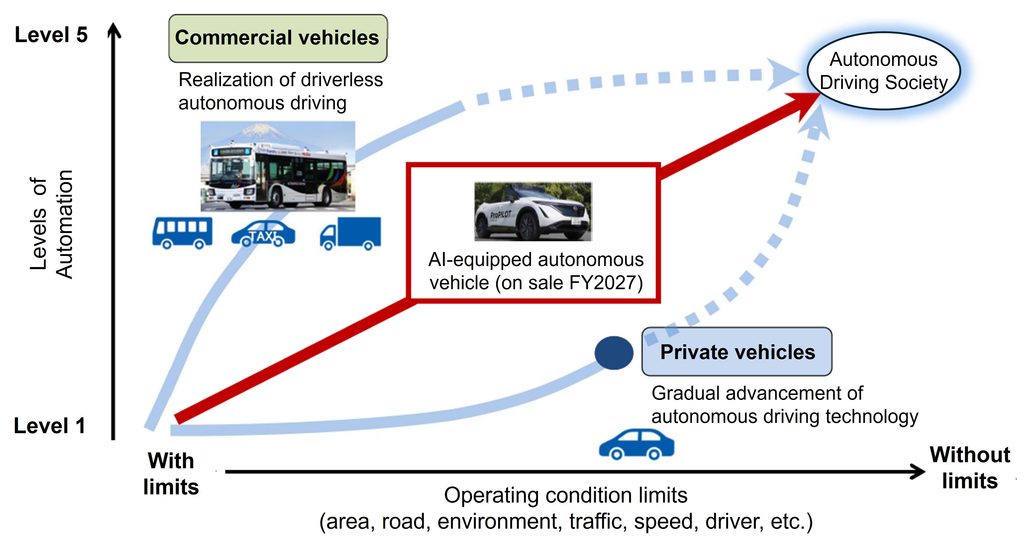
Source: Ministry of Land, Infrastructure, Transport, and Tourism Headquarters for Realizing an Autonomous Driving Society
From demonstration to adoption: Japan’s next stage
Japan’s autonomous driving policy is shifting from a phase of demonstration experiments toward full-scale adoption. The Japanese government has set a goal of deploying 10,000 autonomous driving service vehicles, such as buses, taxis, and trucks, by the end of FY2030.
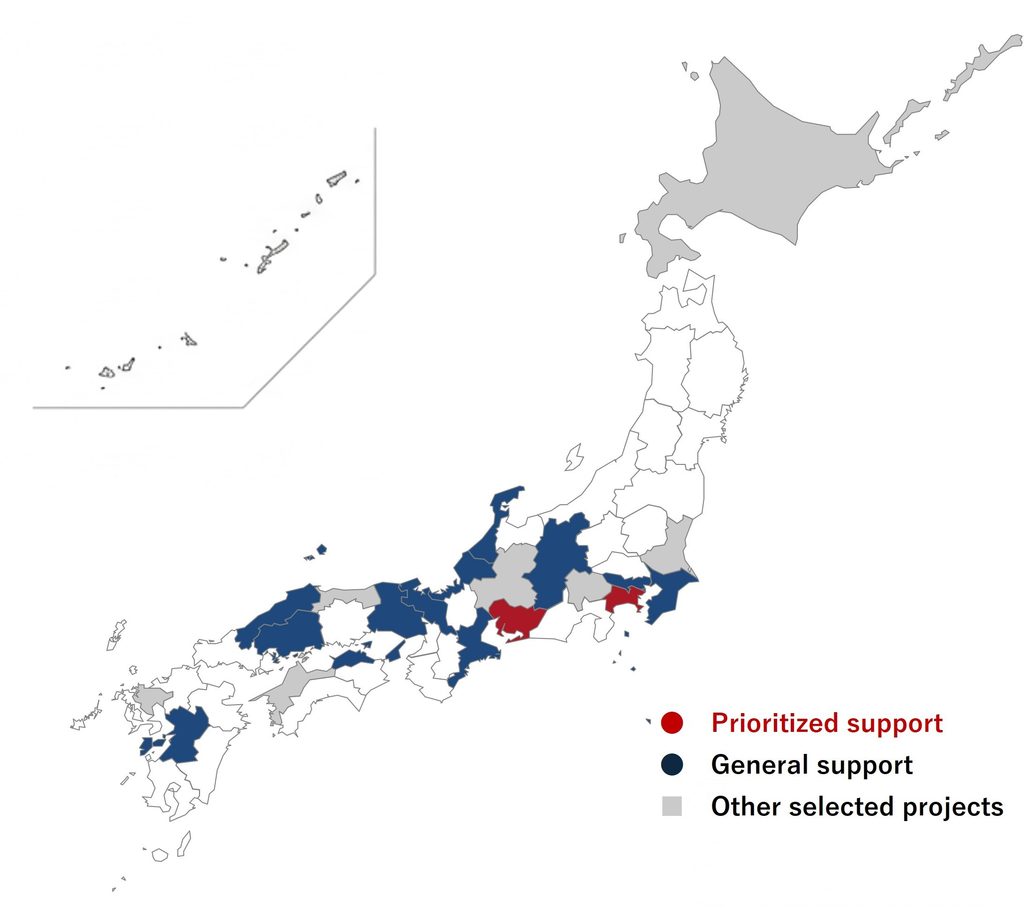
A total of 37 projects were selected nationwide under the Ministry of Land, Infrastructure, Transport and Tourism’s FY2026 Subsidy for Regional Public Transportation Security, Maintenance, and Improvement (Autonomous Driving Social Implementation Promotion Project). With this strong backing from the government, the practical application of autonomous driving services is accelerating. Yet the introduction of vehicles alone does not achieve sustainable mobility services. It will become increasingly important to establish systems that provide ongoing support for autonomous driving, such as training remote monitors to oversee operations, reducing operating costs, and educating maintenance technicians to maintain the specialized vehicles. Addressing these challenges is also key to improving social acceptance, so that local residents can embrace autonomous driving with confidence.
Role in regional transportation infrastructure
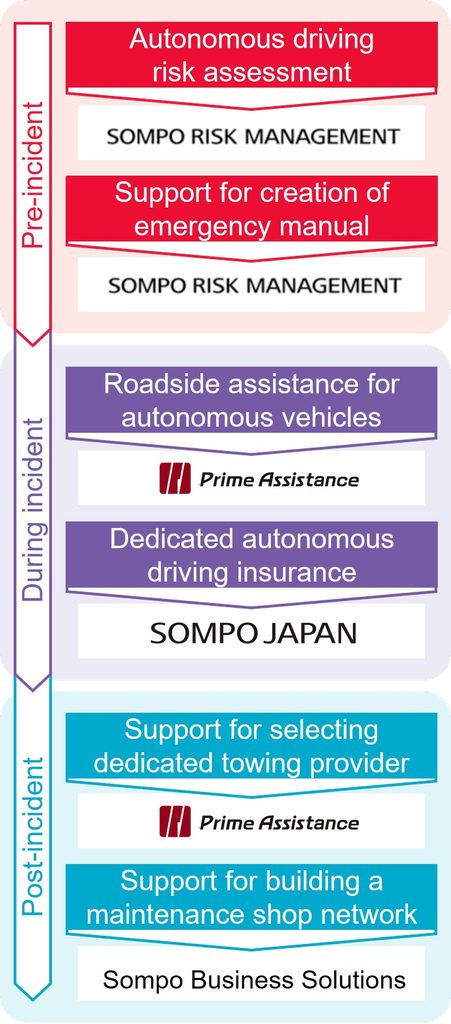
Deploying autonomous driving takes more than technology and vehicles. It also requires a support system covering everything from pre-operation risk assessment to accident response and routine maintenance. Sompo Group is helping address these challenges by leveraging its expertise in insurance and risk management.
By March 2026, Sompo Group had participated in over 170 demonstration experiments nationwide, and it is supporting 18 out of 37 government subsidy projects selected this year.
Specifically, through SOMPO ALCS (Autonomous, Level 4, Comprehensive Support), a package solution that helps local governments and transportation operators in the introduction and deployment of autonomous driving, Sompo Group provides services such as route risk assessment, emergency response, and the establishment of maintenance systems. This is to ensure that autonomous driving does not end as an “experiment” but becomes established as a means of transportation that local residents can use with peace of mind. To that end, Sompo Group continues to develop SOMPO MobineX, an initiative shaping the future of mobility in Japan. We are going beyond the boundaries of insurance and technology and working together with all partners. SOMPO ALCS plays an important role in one of the key domains this initiative delivers value.